
Heddon-on-the-Wall Local History Society
  • Home
  • Calendar
  • Introduction
  • Where are we?
  • History Map
  • Timeline
    • Prehistoric
    • AD43 to 1599
    • 1600 to 1799
    • 1800 to 1899
    • 1900 to 1999
    • 2000 to 2099
  • Heddon's History
    • Prehistory
    • Hadrian's Wall >
      • Vallum excavation (1893)
      • Hadrian's Wall excavation 1926
      • Wall ditch, Bays Leap (1958)
      • Hadrian’s Wall: Archaeological research by English Heritage 1976-2000
      • Throckley & Heddon entanglements
      • WallWatch
      • English Heritage (2020)
      • Wardell-Armstrong Archaeolgy Reports
      • Historic England Archives
    • Six townships >
      • 1 Heddon township >
        • Heddon in the Middle Ages
        • Common Land
        • Middle Marches
        • Tithe Award
        • St Andrew's Church >
          • Stained Glass Windows
          • Churchyard
          • Monuments of church & churchyard (1991)
          • Monuments Page 2
          • Vicars of Heddon
        • Village property
        • Heddon Hall >
          • Sale of Heddon Hall 2012
        • Heddon Banks Farm
        • Frenchman's Row
        • Methodist Church >
          • Heddon Methodist Church Centenary 1877-1977
        • Men's Institute
        • Women's Institute
        • Welfare Field
        • Knott Memorial Hall
        • Memorial Park
        • Schools
        • River Tyne
        • Coal Mining
        • Quarrying
        • Water Supplies
        • Transport
        • Waggonway & Railway
        • Occupations from 1800
        • Miscellaneous
      • 2 West Heddon township
      • 3 East Heddon township
      • 4 Houghton & Close House township >
        • Close House
      • 5 Eachwick township
      • 6 Whitchester township
    • Rudchester
  • People
    • Sir James Knott
    • Cadwallader J. Bates
    • Richard Burdon
    • Hugh Sinclair (Tim) Swann
    • George Clark
  • Old Photos
    • Postcards
    • Old photos 1
    • Old photos 2
    • Old photos 3
    • Old photos 4
    • Old photos 5
    • Old photos 6
    • Old Photos 7
  • Old News
    • Community News
    • Letter from the Emigrant Clergy of Frenchman's Row (1802)
    • Alleged Brutal Murder at Heddon-on-the-Wall (1876)
    • Sad boat accident at Ryton (1877)
    • Coronation tree (1902)
    • 65 Years on a Ferry Boat (1929)
    • Come claim your kiss at Heddon (1953)
    • The Swan (1972)
    • Heddon WI (1987)
    • Church House (1966)
    • Happy return (1993)
    • Hexham Courant (1997)
    • Butterfly Garden (1999)
    • Foot & Mouth (2001)
    • Remembrance Day (1996)
    • Remembrance Day (2016)
    • RAF at Ouston (2007)
    • Close House Golf Course (2009)
    • Heddon pupils celebrate British heritage (2011)
    • Roman Wall Forge (2011)
    • Diamond Jubilee (2012)
    • Auction of Bronze Statue, Close House (2012)
    • Heddon WI (2012)
    • Puffing Billy Festival (2013)
    • Heddon Village Show (2014)
    • View of the North (2014)
    • The Wall at Heddon (2014)
    • Heddon Village Show (2015)
    • War veterans singing send-off (September 2015)
    • Anglo-Saxon history (2014)
    • Heddon WI at 100 (2017)
    • Hadrian's Wall discovery (2019)
    • Tulip Mews (2020)
    • Mike Furlonger
    • Hadrian's Wall 1900 Festival
  • Memories
    • Olive White
    • Betty Cockburn
    • Betty Cockburn - miscellaneous information
    • Isabel Snowdon
    • William & Winnie Watson
    • Edith Ward
    • Mark Parker
    • Jack Lawson
    • Winnie Spoor
    • P Reay
    • Mr and Mrs Hall
    • Peter Chapman
    • Elizabeth Elenora Eames
    • Harry Murray
  • Other documents
    • Mackenzie (1825)
    • Bates (1886) >
      • Early & Roman
      • Townships
      • Heddon Church
      • Heddon & Houghton
      • Whitchester
      • Eachwick
      • West & East Heddon
      • Records
      • Addenda
      • Appendix A
    • History, Topography & Directory of Northumberland (Bulmer's) - 1886
    • History of Northumberland (1930)
    • Collingwood Bruce (1853)
    • Whellan (1855)
    • Post Office Directory (1879)
    • Prominent people in Heddon
    • Place names
    • Ad Murum
    • Archived documents
    • Thomas Bewick's History of British Birds (1826)
    • Census data 1801-1991
    • Historical Records 1888-1890
    • Knott Sale of Village Property (1924)
    • Extracts from Parish Council Records
    • Local colliery records
    • Blackburn (1938)
    • Clark (c.1963)
    • History of Church (1968)
    • Boundary Commission Report 1984
    • Village Atlas 2022
  • Walks
    • Walks 2
  • Blog
  • Contact us
  • Links
  • What's new
  • Site search
  • Past & Present
  • Photo of the Month
  • Place Name Studies
    • Meas & Meres
    • OS Name Books: Elsdon
    • OS Name Books: Allendale
    • OS Name Books: Cheviot Hills
    • OS Name Books: Other Parishes
  • Heddon 3D landscape

Roman Fort & Camp, Blakehope

16/2/2026

0 Comments

 
Picture
LIDAR (DSM, 1m) copyright Environment Agency (2022) - enhanced for archaeology.
Blakehope, Otterburn, Northumberland.

The monument includes the remains of a Roman fort contained within the partial remains of a larger Roman temporary camp, situated on gently sloping ground adjacent to the Dere Street Roman road. The Roman fort is visible as a rectangular enclosure with rounded corners measuring approximately 128m by 119m and orientated NW to SE; it is defined by a single turf built rampart with an outer ditch visible as intermittent low earthworks. There are at least two recorded entrances. A small excavation within the Roman fort indicated it to be pre-Hadrianic in date. The fort is situated within a larger enclosure, interpreted as a Roman temporary camp. This enclosure is defined by a rampart with an internal and external ditch which are partially visible as slight earthworks on the W, N and NW sides. The temporary camp is cut by the Roman Road Dere Street indicating that the road is later than the camp.

Scheduled Monument:
https://historicengland.org.uk/.../the.../list-entry/1006507


Keys to the Past: N8278
Picture
Archaeology in Northumberland Vol. 15 p.39 (2005).
0 Comments

Bellshiel Neolithic Long Cairn

10/2/2026

0 Comments

 
Bellshiel Neolithic Long Cairn, Northumberland.

A Long Cairn occupies the crest of a narrow ridge in open moorland (fenced after scheduling) at about 300m above sea level. Orientated at an angle of 279 degrees, it is partially earth covered on the north side. It has a maximum height of 1.6m, length of 109m, and varies in breadth between 15m in the east and 8.8m in the west. The cairn was excavated in 1935 when a possible cist and a rock cut grave were found and cup marked stones noted nearby (later described only as water-worn depressions). Little was found and the excavator called the mound a 'monster of degeneracy'. It was not possible to date it securely to the Neolithic period.

A stone-walled enclosure attached to the S side of the cairn is a later feature re-using stones from the cairn.
Long cairns are the burial places of Britain's early farming communities and, as such, are amongst the oldest field monuments surviving visibly in the present landscape. Where investigated, they appear to have been used for communal burial, often with only parts of the human remains having been selected for interment.

https://www.geograph.org.uk/photo/5363312
0 Comments

Enclosures, Whitelee

6/2/2026

0 Comments

 
Whitelee, Redesdale, Northumberland.

Location: NT 714 050


Rectilinear enclosures such as those shown here are usually assumed to be used for control of animals on the farm (sheep or cattle). They are usually made of low banks of turf or earth, have no entrance, and are probably not that old (post-medieval). However, to keep stock in (or out) they must have had a surrounding fence or hedge, and a gate. What is unusual here is that there are nine regular enclosures (and another faint triangular one in the centre), and several of them overlap. Does this give us any clue as to how they were used? If they were required seasonally (e.g. for lambing) why not just reuse one already made rather than create a new one? The small recangular and circular banked enclosures are probably stack stands, dug and also fenced to protect stacks of winter fodder from the animals.

K2P: 
N36572

"Unusual rectilinear enclosure, east of Whitelee Bridge, with four separate surrounding banks in places, perhaps indicative of different phases of construction. Clearly visible on lidar imagery. Unlike anything else noted in Redesdale. Nothing shown here on historic Ordnance Survey maps. Several other rectilinear enclosures in the vicinity are clearly related, all presumably linked to post-medieval agriculture."
Picture
LIDAR (DSM, 1m) copyright Environment Agency (2022) - enhanced for archaeology.
0 Comments

Dour Hill long cairn & round cairn

6/2/2026

0 Comments

 
Dour Hill, Redesdale, Northumberland.

Chambered/Long Cairn & Round Cairn just visible among the detritus of clear-felled forest plantation. Both sites are Scheduled Monuments protected by law.

K2P: N67


Picture
LIDAR (DSM, 1m) copyright Environment Agency (2022) - enhanced for archaeology.
Picture
© Peter McDermott (cc-by-sa/2.0) Long cairn at Kip End, Dour Hill taken Saturday, 3 January, 2009 https://www.geograph.org.uk/photo/1104550
0 Comments

Three Romano-British enclosed settlements near Nether Houses

4/2/2026

0 Comments

 
Nether Houses, Rochester, Northumberland.

Location: NY 823 969

K2P: N8099
K2P: N8100
K2P: N8101

One to the NW close to the sheep-shelter (bield). Well preserved settlement to its SE and the third hidden by trees (on DSM) in a fairly recent forestry plantation.

There are faint impressions of a field system close to the settlements and also a few unenclosed hut circles which may relate to an earlier or contemporary period.
LIDAR (DSM, 1m) copyright Environment Agency (2022) - enhanced for archaeology.
LIDAR (DTM, 1m) copyright Environment Agency (2022) - enhanced for archaeology.
0 Comments

Catcleugh Reservoir

4/2/2026

0 Comments

 
Catcleugh Reservoir, Redesdale, Northumberland.

Catcleugh Reservoir was constructed between 1884 and 1905 in the upper valley of the River Rede for the Newcastle & Gateshead Water Company. The accompanying LIDAR images show the dam and associated works at the east end of the reservoir (stepped overflow, and outlet of tunnel for compensation water), and the shadowy remains of the hutted villages located both north and south of the river, east of the dam, which were used by the construction workers (navvies). Compare to the schematic plan of the dam area showing the line of the old and modern roads, and the several lines of the narrow-gauge railway used in the construction.

Northumberland National Park: Catcleugh Reservoir

Picture
LIDAR (DTM, 1m) copyright Environment Agency (2022) - enhanced for archaeology.
Picture
Schematic plan of the area of Catcleugh Dam - Northumberland National Park.
The last 'Black House' at Catcleugh Reservoir
"In time to come when navvies meet
Upon some distant job
They'll cast their mind
Back o'er the years
That time doth from us rob
And in a drop of prime old stuff
They'll talk upon the happy days
They had up at the 'Cleugh'"

From 'The Cleugh' by Billy Bell, Redesdale roadman and Border Bard (1904)
0 Comments

Roman temporary camps, Bellshiel, Otterburn

3/2/2026

0 Comments

 
Three Roman temporary camps along Dere Street at Bellshiel & Sills Burn, Otterburn MOD Ranges, Northumberland.

The mounds within the western (largest) camp are bell-pits from coal mining, apart from one on the highest point which is thought to be a Bronze Age burial mound (tumulus). The mining clearly post-dates the rig & furrow cultivation as do the internal enclosure banks. LIDAR interestingly shows traces of the road connecting the east gate of the fort (and passing to both sides of the exterior traverse) to Dere Street now followed by a modern military road.

K2P: 
N8087
K2P: N8095
K2P: N328


The three camps are Scheduled Monuments protected by law.
Picture
LIDAR (DSM, 1m) copyright Environment Agency (2022) - enhanced for archaeology.
0 Comments

Roman temporary camp at Bagraw

30/1/2026

0 Comments

 
Picture
LIDAR (DSM, 1m) copyright Environment Agency (2022) - enhanced for archaeology.
Another Roman temporary (or marching) camp along Dere Street at Bagraw in Redesdale, Northumberland.

The camp is elongated from NW to SE and has been either extended or reduced in size at some time. It is squeezed onto a limited space of flat land with its W side closely parallel to the Dere Street Roman Road, and its E side above the Bagraw Burn. The camp has been cut by the modern road (A68), here taking a separate line to the Romans, although both headed towards the Scottish Border north of the River Rede (bottom left), crosssed by both roads not far to the south. The NE side of the camp is overlaid by a forested enclosure (now partly clear-felled). LIDAR reveals one of the internal roads through the northern section of the camp between its original opposing N & S gates, demonstrating its assymetric and unusual construction.

Scheduled Monument: 1006506

K2P: N8104

Picture
0 Comments

WW1 practice trenches, Silloans

30/1/2026

0 Comments

 
World War I practice trenches, Silloans on the Otterburn Ranges, Northumberland.

"Their primary purpose was to train infantry companies in the routine of defence, control of overhead artillery fire and relief in the line during World War I. The trenches, which face northwards, are visible as a series of earthworks covering an area of about 240m north west to south east by 150m north east to south west. The plan of the trenches, which is best appreciated from the air, includes a front line fire trench, a support, or reserve, line and associated communications trenches.

The front line, which lies at the northern extremity of the complex, is visible as a fire trench of `bastion trace' or diamond-shape layout with four interlinked bastions. Each bastion has a parados or mound of earth to the rear, offering protection against reverse fire and the back burst of high explosive shells. Communication trenches link the bastions and run behind the parados in each case, turning them into isolated mounds up to 1.5m high. A support or reserve line lies between 60m and 70m to the south of the front line, connected to it by a further set of three similar bastions each with an isolated parados. The form of the reserve line is of `square trace' or fire trench with traverses. Communication trenches with a zigzag profile run southwards from the east and west ends of the reserve line for 80m and 90m respectively at which point they converge. From this point further short lengths of trench of a similar form continue to the south and east."

Scheduled Monument protected by law: 1021025

Archaeology in Northumberland, volume 14 (2004)
Picture
0 Comments

The Reedwater Minstrel

7/11/2019

1 Comment

 
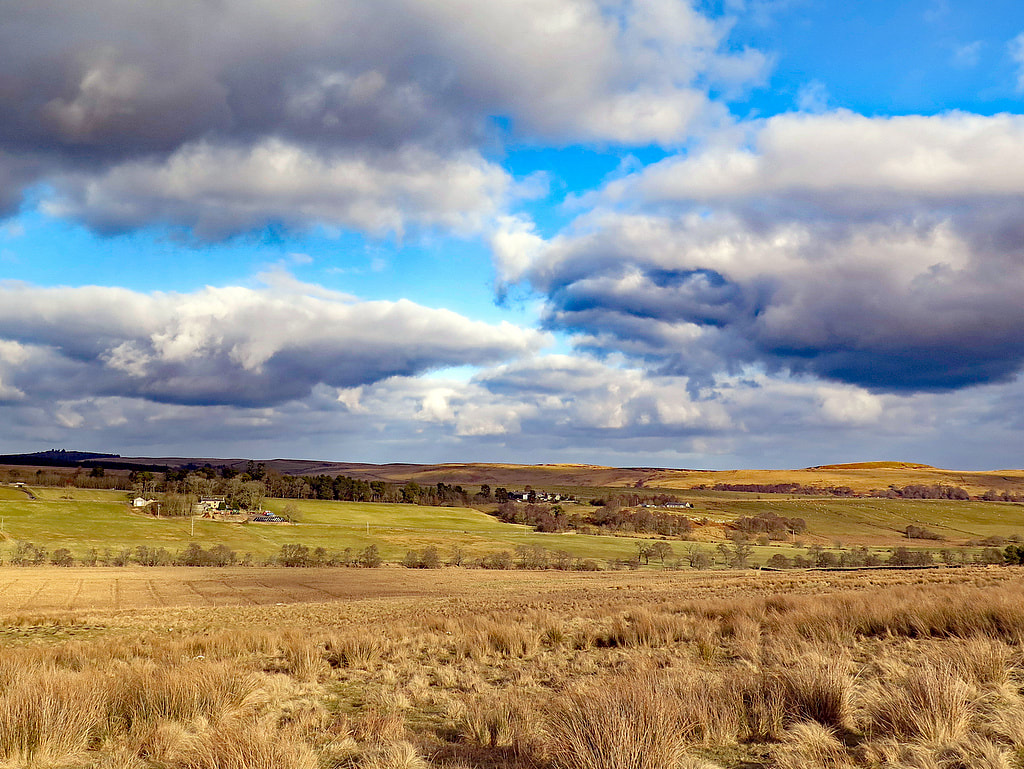
This last couple of years has seen me doing some exploring and more detailed archaeology in Redesdale. It is beautiful, wild Northumberland countryside with a wealth of wildlife, history and tradition. I have had the honour to work alongside local  people and other like-minded folk from Tynedale Archaeology Group as a volunteer on the National Lottery funded Revitalising Redesdale project.
Picture
Redesdale from moorland west of Rattenraw. A Curtis (2018).
Another computer-based project is now drawing to a conclusion, that of transcribing the Northumberland Ordnance Survey Name Books of the 1860's first survey, a project led by Professor Diana Whalley. The last parish to be transcribed was Elsdon (including Rochester, Otterburn and a few parts of other parishes, before boundary changes) with about 800 interesting and often informative place-names. Involvement with this project has led me to this post.
Given as an authority to the spelling of one of the place-names in the parish was a reference to  'The Lay of the Reedwater Minstrel'. It is a poem by Robert Roxby, and reading it makes you aware that not only was he too facinated by the place-names of the area but also appeared to know them intimately as places, along with a few of the local inhabitants.
“He’ll sing Reedwater’s muirlands wild,
Where whirring heath-cocks flee,
Where limpid wells and heather bells
Delight the sportsman’s e’e.”
This quotation is used on page 13 of the Revitalising Redesdale: Landscape Conservation Action Plan (LCAP-Part 1) published in July 2017.

Read More
1 Comment

    RSS Feed

    Author

    Andy Curtis

    Archives

    March 2026
    February 2026
    January 2026
    October 2025
    August 2025
    July 2025
    May 2025
    November 2024
    July 2024
    June 2024
    May 2024
    April 2024
    March 2024
    January 2024
    November 2023
    February 2023
    November 2022
    September 2022
    August 2022
    June 2022
    May 2022
    January 2022
    December 2021
    November 2021
    September 2021
    August 2021
    June 2021
    May 2021
    October 2020
    June 2020
    May 2020
    March 2020
    November 2019
    August 2019
    July 2019
    March 2019
    January 2019
    November 2018
    October 2018
    August 2018
    July 2018
    June 2018
    April 2018
    March 2018
    January 2018
    October 2017
    September 2017
    July 2017
    June 2017
    May 2017
    April 2017
    March 2017
    February 2017
    January 2017
    December 2016
    November 2016
    September 2016
    August 2016
    July 2016
    June 2016
    May 2016
    April 2016
    February 2016
    January 2016
    December 2015
    October 2015
    September 2015
    August 2015
    July 2015
    June 2015
    May 2015
    April 2015
    March 2015
    February 2015
    January 2015
    December 2014
    November 2014
    September 2014
    August 2014
    July 2014
    June 2014
    May 2014
    April 2014
    March 2014
    February 2014
    January 2014
    December 2013
    October 2013
    September 2013
    August 2013
    July 2013
    June 2013
    May 2013
    April 2013
    March 2013
    February 2013
    January 2013
    December 2012
    November 2012
    October 2012
    September 2012
    August 2012
    July 2012
    June 2012
    May 2012
    April 2012
    March 2012
    December 2011
    November 2011
    October 2011
    September 2011
    August 2011
    June 2011
    May 2011
    April 2011
    March 2011
    February 2011


    Categories

    All
    Aerial Photography
    Agricultural Engineering
    Archaeology
    Barrow
    Bays Leap
    Beamish Museum
    Beer
    Beer-mat
    Berwick
    Bewcastle
    Books
    Border Line
    Brewery
    Brown
    Cabinetmaker
    Castle
    Charlton
    Cheviots
    Churches
    Civil War
    Clennell Street
    Close House
    Coal Mining
    Cullercoats
    Cumbria
    Dmv
    Durham
    Eachwick
    Earl Grey
    Elswick
    Family History
    Fishing
    Fishwives
    Folkestone Warren
    Forth Banks
    Furniture
    Gardens
    General
    Geology
    George Clark
    Gibson
    Goods Station
    Hadrian's Wall
    Harbours
    Heddon
    Heddon Hall
    Hexham
    Hidden Chains
    Hillfort
    Horsley
    Houghton
    Howick Hall
    Hunting
    Iron Sign
    Isaac Jackson
    John Grundy
    John Smith
    Knott
    Landscape
    Landslide
    Lead Works
    Lemington
    Lidar
    Lindisfarne
    Maritime
    Meetings
    Military Road
    Mill
    Monument
    Newburn
    Newcastle
    Newcastle Assizes
    News
    North Lodge
    North Shields
    Northumberland
    Northumberland Records Office
    Old Middleton
    Oral History
    Ouseburn
    Outings
    Photography
    Pit
    Place Names
    Place-names
    Ponteland
    Ports
    Postcards
    Prehistory
    Pubs
    Quarries
    Railways
    Redesdale
    River Tyne
    Rman
    Rock Art
    Roman
    Sadler
    Sanderson
    Schools
    Seaton Delaval
    Ships
    Shot Tower
    Slave Trade
    Songs/Poems
    Spearman
    Stagecoach
    Stained Glass
    St. Andrews
    Stephenson
    Swann
    Tea Robbery
    Throckley
    Town Farm
    Transportation
    Trinity House
    Tyne & Wear
    Victorian Panorama
    Walbottle
    Walk
    Water Supply
    William Brown
    Williamson
    Woodhorn
    Ww1
    Ww2
    Wylam
    Yetholm

Powered by Create your own unique website with customizable templates.
