
Worm (Old English: wyrm) is a local word for a serpent or dragon. There are many legends or folk-lore tales regarding such mythical creatures and how they terrorised their districts before being vanquished by a local hero. Some may go back a long way in time with the stories endlessly retold and embellished.
The Lambton Worm is a much better known tale from the River Wear area of County Durham and is one of the area's most famous pieces of folklore. The Linton Worm from the Scottish Borders is similar.
The Lambton Worm is a much better known tale from the River Wear area of County Durham and is one of the area's most famous pieces of folklore. The Linton Worm from the Scottish Borders is similar.
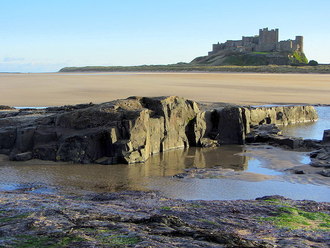
Bamburgh Castle from Harkess Rocks. Photo by A Curtis (2014).
The Laidley Worm is Northumberland's alternative from the Bamburgh area but although all these stories were all presumably originally made up, this particular tale doesn't seem to have quite the same historical longevity.

The Laidley Worm of Spindleston-Heugh was first published in a collection of songs, The Northumberland Garland. As shown above the song is described as:
A song above 500 years old, made by the old mountain-bard, Duncan Frasier, living on Cheviot, A.D. 1270.
Printed from an ancient manuscript.
(By Mr Robert Lambe, Vicar of Norham)
The Northumberland Garland or Newcastle Nightingale: a matchless collection of famous songs) edited by Joseph Ritson (1752-1803) was included as Volume 3 (dated 1793) in the four volume work, The Northern Garlands published by R Triphook, St. James's Street, London in 1810.
Ritson's Garland series were important, not only as important documents in their own right, but as one of the main sources of similar successor publications such as John Bell's Rhymes of Northern Bards and Bruce and Stokoe's Northumbrian Minstrelsy.
Ritson's Garland series were important, not only as important documents in their own right, but as one of the main sources of similar successor publications such as John Bell's Rhymes of Northern Bards and Bruce and Stokoe's Northumbrian Minstrelsy.
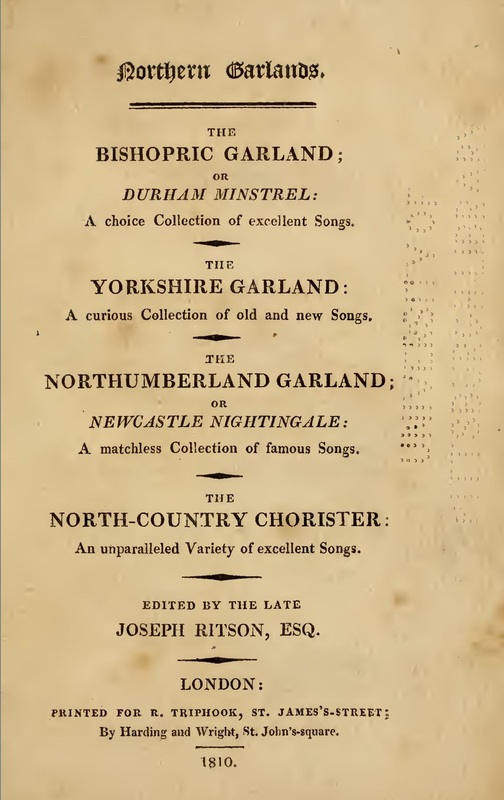
The writings of Duncan Frasier are described as being 'in Latin', presumably the introductory verse is an example. However, the sole work attributed to Frasier is The Laidley Worm and it is now considered most likely that this was in fact a fabrication by the Rev. Lambe himself.
Rev. Robert Lambe, Vicar of Norham, died in Edinburgh in 1795, aged 84 (Scots Magazine Vol.57, p.344. He was also involved with another work in verse: An Exact and Circumstantial History of the Battle of Floddon, published by R Taylor in 1774. With similarities to his Worm poem It was described as:
Written about the Time of Queen Elizabeth. In which are Related Many Particular Facts Not to be Found in the English History. Published from a Curious Ms. in the Possession of John Askew of Palinsburn ...with notes, by Robert Lambe.
The Oxford Book of National Biography entry for Lambe states:
An Exact and Circumstantial History of the Battle of Flodden (1774), appears to have been based on Thomas Gent's edition of a manuscript belonging to John Askew of Pallinsburn, Northumberland, and was embellished with Lambe's notes, which, he claimed, recorded authentic historical events. However, stories such as his description of St Cuthbert's body floating down the Tweed in a stone coffin were the product of his mischievous imagination. Likewise he maintained that his poem ‘The Laidley Worm of Spindleston Heugh’ was translated from a song composed by a mystical bard living in the Cheviots in the thirteenth century. This hoax fooled William Hutchinson, who included the poem in his History of Northumberland [A View of Northumberland p.162 pub.1778], and some of Lambe's purported archaeological discoveries were also practical jokes intended to catch out his fellow antiquaries.
The Rev. Lambe's story, if that's what it is, bears much similarity with a ballad from the Scottish Borders called Kempion or Kemp Owyne, collected and published by Sir Walter Scott in his Minstrelsy of the Scottish Borders (1802). On p85 Scott makes the comment:
There are numerous traditions, upon the borders, concerning huge and destructive snakes, althouth the common adder, and blind worm, are the only reptiles of that genus now known to haunt our wilds. Whether it be possible, that, at an early period, before the country was drained and cleared of wood, serpents of a larger size may have existed, is a question which the editor leaves to the naturalist. But, not to mention the fabulous dragon slain in Northumberland by Sir Bevis, the fame still survives of many a preux chevalier, supposed to have distinguished himself by similar aichievements.
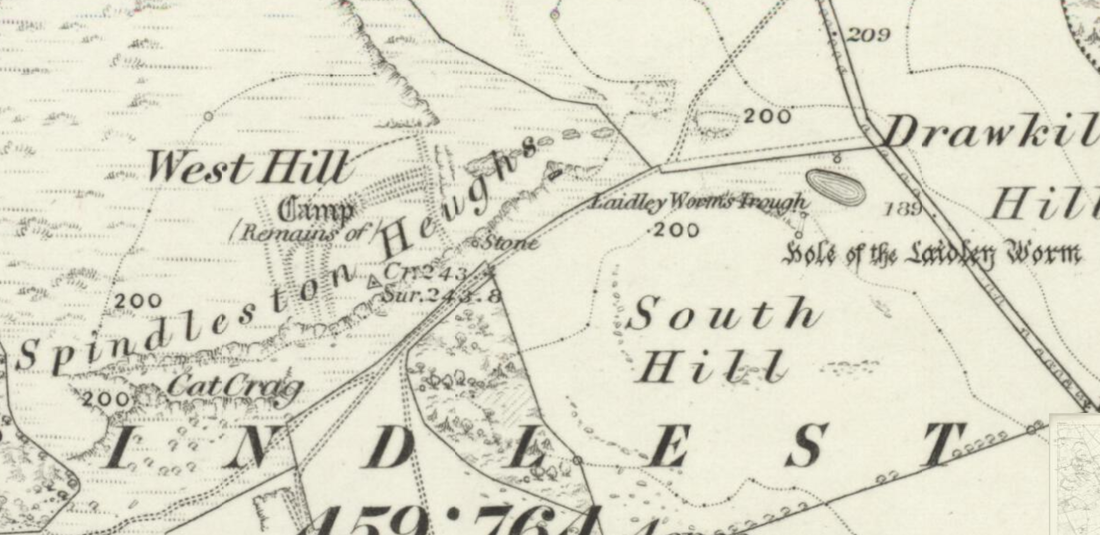
Ordnance Survey, Northumberland Sheet XVI, Surveyed: 1860, Published: 1865.
The ballad of the Laidley Worm tells how a King of Northumbria brings home to Bamburgh Castle a new wife who is jealous of her step-daughter, the princess Margaret, and turns her into a 'Laidley Worm'. Laidley or laidly is a Geordie dialect word for loathly meaning loathsome.
The milk of seven cows is served to her daily in a trough at the foot of Spindlestone Heugh where she makes her lair, but though her diet is mild, the countryside is blasted by her venomous breath.
The milk of seven cows is served to her daily in a trough at the foot of Spindlestone Heugh where she makes her lair, but though her diet is mild, the countryside is blasted by her venomous breath.
For seven miles east, and seven miles west,
And seven miles north, and south,
No blade of grass or corn could grow,
So venomous was her mouth.
The milk of seven stately cows,
It was costly her to keep,
Was brought her daily, which she drank
Before she went to sleep.
At this day may be seen the cave.
Which held her folded up,
And the stone trough, the very same
Out of which she did sup.
Word went east, and word went west,
And word is gone over the sea.
That a Laidley worm in Spindleston-Heughs Would ruin the North Country.
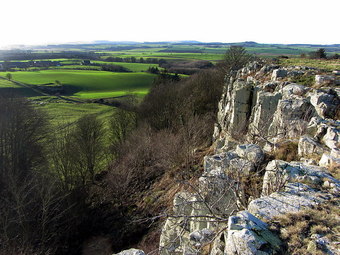
Whin Sill at Spindlestone Heughs. Photo A Curtis (2014).
News of the devastation reaches Margaret’s brother, the heir of Bamburgh, Childe Wynd, far beyond the sea, and he and his 33 men set sail for Northumbria. Despite the wicked queen's attempts to keep them from landing by sending out witches, the boat is protected by wood of the rowan tree and they come safely ashore at Budle Sands.
The term, Childe, is now obsolete but is Old English for a young noblman who had not yet attained knighthood, or not yet won his spurs.Does Wynd come from the local term for a narrow street or even the road called Wynding in Bamburgh?
The term, Childe, is now obsolete but is Old English for a young noblman who had not yet attained knighthood, or not yet won his spurs.Does Wynd come from the local term for a narrow street or even the road called Wynding in Bamburgh?
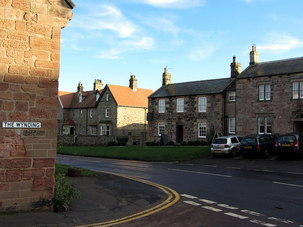
The Wynding, a road off Front Street in Bamburgh. Is this the origin of the name Childe Wynd? Photo A Curtis (2014).
The spells were vain; the hags returned
To the queen in sorrowful mood,
Crying that witches have no power,
Where there is rown-tree wood.
Her last effort, she sent a boat,
Which in the haven lay,
With armed men to board the ship,
But they were driven away.
The worm lept out, the worm lept down,
She plaited round the stone;
And ay as the ship came to the land
She banged it off again.
The child then ran out of her reach
The ship on Budley-sand;
And jumping into the shallow sea.
Securely got to land.
The Rowan tree or Mountain Ash was always considered to guard against witches and their evil spells.
Childe Wynd with sword in hand, advances on the Worm. Margaret cries out to him to break the spell by kissing her three times, which he does, and reveals his sister.
O! quit thy sword and bend thy bow,
And give me kisses three;
For though I am a poisonous worm.
No hurt I'll do to thee.
O! quit thy sword, and bend thy bow,
And give me kisses three;
If I'm not won, e'er the sun go down,
Won I shall never be.
He quitted his sword and bent his bow,
He gave her kisses three;
She crept into a hole a worm,
But out stept a lady.
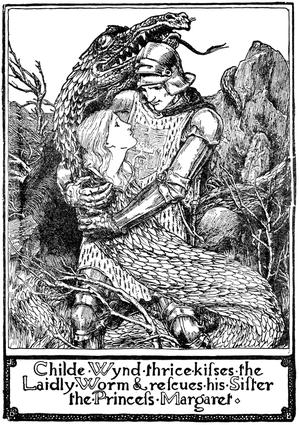
Childe Wynd thrice kisses the laidly worm. Illustration by John D. Batten, 1890.
They confront the wicked queen and by turning her own spell back on her, change her into a hideous toad.
Now on the sand near Ida's tower,
She crawls a loathsome toad,
And venom spits on every maid
She meets upon her road.
The virgins all of Bambrough town
Will swear that they have seen
This spiteful toad, of monstrous size.
Whilst walking they have been.
All folks believe within the shire
This story to be true,
And they all run to Spindleston,
The cave and trough to view.
This fact now Duncan Frasier
Of Cheviot, sings in rhime;
Lest Bambrough-shire-men should forget
Some part of it in time.
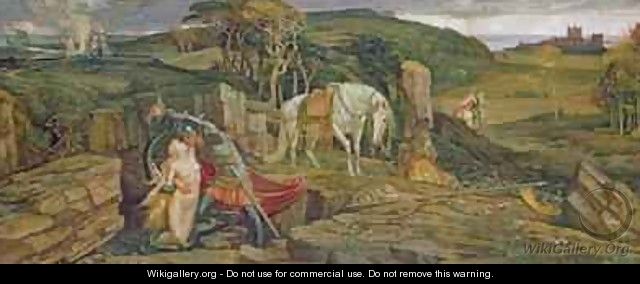
The Laidly Worm of Spindleston Heugh by Walter Crane (1881).
See also Walter Crane's pencil sketch made for this painting: Study for The Laidley Worm of Spindleston Heugh.
Bamburgh Castle is shown on the right and a ship in Budle Bay on the left. The geography is good. In the centre is an accurate representation of the Spindle Stone used to restrain Childe's horse. This explains its alternative name, the Bridle Stone.
Bamburgh Castle is shown on the right and a ship in Budle Bay on the left. The geography is good. In the centre is an accurate representation of the Spindle Stone used to restrain Childe's horse. This explains its alternative name, the Bridle Stone.
The Linton Worm is said to have lived a hollow on the north-east side of Linton Hill in Roxburghshire still known as the 'Worm’s Den'. However, it's lair does not seem to have been recorded by the Ordnance Survey as is the case for the Laidley Worm.
It has been suggested that hollows and embankments in the landscape associated for example with Iron Age hillforts or camps may have been explained by the existence of mythical serpents. One such camp exits on the summit of Spindlestone Heughs overlooking Budle Bay.
It has been suggested that hollows and embankments in the landscape associated for example with Iron Age hillforts or camps may have been explained by the existence of mythical serpents. One such camp exits on the summit of Spindlestone Heughs overlooking Budle Bay.
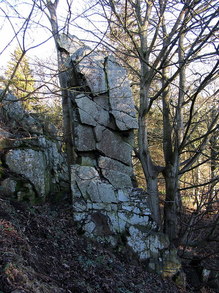
The Spindle Stone, Spindlestone Heughs. Photo A Curtis (2014).
Wayne Phillips, whose photograph of the Spindle Stone I had originally used in an article on the Named Stones of Northumberland, told me that he had visited with his family in February 2009 and on the way back come across a large toad hopping across the footpath. According to the legend of the Laidley Worm the wicked Queen was turned into a loathsome toad and spits venom on every maid she meets upon the road.
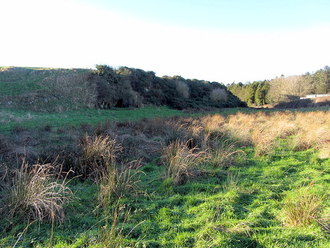
Trough of the Laidley Worm, Spindlestone. Photo A Curtis (2014).
The Berwickshire Naturalists' Club visited Bamburgh in June 1924. The account is described in their Proceedings, vol 25 part II, p.14):
Leaving the fort [Spindlestone Heughs] the party next visited the Laidley Trow [Trough], a rectangular stone trough receiving the water which trickles from a low bluff close to the marshy lair of the legendary worm; the marsh was bright with the yellow flowers of the flag iris.
The Spindle Stone is a detached pillar of Whin Sill east of the high crags of Spindlestone Heughs. The drawing of the Spindle Stone included in their report shows that the woodland is much denser below the crags these days. The 'Trough of the Laidly Worm' now seems to refer to a pond, now drained in the field just south of Waren Caravan Park.
The stone trough, out of which the dragon daily drank the milk of seven cows, can no longer be found. The low crag of Whin Sill, defending the north side of South Hill above the marsh, is the likely location of the 'Hole of the Laidly Worm' which may be a spring said to emerge through a hole at the east end of the crags. The first edition OS 6" scale map (1865) shows a likely connection between the hole (spring) and the trough south-east of the pond.
The trough is shown just south of the pond on quite recent large-scale maps. Jean Terry in Northumberland Yesterday and To-day wrote in 1913 that:
"The Spindlestone, a tall crag on which the young knight hung his bridle when he went further on to seek the worm in the 'heugh,' is still to be seen, but the huge trough from which the worm was said to drink has been destroyed."
The stone trough, out of which the dragon daily drank the milk of seven cows, can no longer be found. The low crag of Whin Sill, defending the north side of South Hill above the marsh, is the likely location of the 'Hole of the Laidly Worm' which may be a spring said to emerge through a hole at the east end of the crags. The first edition OS 6" scale map (1865) shows a likely connection between the hole (spring) and the trough south-east of the pond.
The trough is shown just south of the pond on quite recent large-scale maps. Jean Terry in Northumberland Yesterday and To-day wrote in 1913 that:
"The Spindlestone, a tall crag on which the young knight hung his bridle when he went further on to seek the worm in the 'heugh,' is still to be seen, but the huge trough from which the worm was said to drink has been destroyed."
Links
BBC Radio 4 Landlines1 Landlines2
Myths & Legends: The Laidly Worm of Spindleston Heugh
BBC Radio 4 Landlines1 Landlines2
Myths & Legends: The Laidly Worm of Spindleston Heugh
 RSS Feed
